ARTISANAL

As in the best stories about fashion designers, Martin Margiela’s peculiar talent bloomed during the training at the Royal Academy of Fine Arts in Antwerp (1977-1980). He had the chance to attend the Fashion department in the same years of the “Antwerp Six“, a group of designers (graduate between 1980 and 1981) that captured the attention of the international press breaking into the London Fashion Week in 1988. Actually Margiela is generally considered as the seventh symbolic member, despite he wasn’t physically part of the group set up by Walter Van Beirendonck, Ann Demeulemeester, Dries van Noten, Dirk Van Saene, Dirk Bikkembergs and Marina Yee. Their styles were similar and were inspired by the designer Rei Kawakubo (founder of the brand Comme des Garçons) which influenced the Japanese fashion of the 70s with asymmetric cuts and black and white collections.


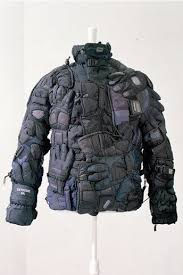
The maison’s approach to haute couture has been similarly unique. From its earliest days, Margiela’s Artisanal line has exploited the inherent qualities of found materials. With exacting craftsmanship, old matter is regularly overdyed, embellished, and pieced together in new formations. These exercises extend the life-span of things that might otherwise be rendered worthless, while remaining true to the investment in technique and customization that characterizes a couture garment. All the examplars from this first Artisanal collection, are composing by object reduced to useless shards or old items and then reincarnated with careful handwork.The red paint stained cloth used as catwalk for the first show, was re-used six month later as fabric for the waistcoats of the Fall Winter 1989/1990 collection. The use of second-hand clothes and imperfect fabrics was a blatant act of rebellion against the widespread consumerism and consecrated Margiela as a conceptual designer, conflicting with the conformist fashion of the 80s, just as the hippies had done twenty years before, buying their dressed only at flea markets.
"A designer who founded his brand 17 years ago in rebellion against what he saw as the galloping consumerism of the 1980s. His winter 1989 show attracted an audience with an advertisement in a Paris free sheet and ended with models wearing the white cotton coats that are the uniform of all Margiela’s staff. Cloth printed with tattoos, vests made from broken crockery, boots with separated toes, sweaters created from army socks and clothes covered in plastic dry-cleaner wrappings were all early signals of Margiela’s fetish for recycling, for unfinished effects and for giving everyday objects a dysfunctional beauty… But in tandem with the more outré examples or one-off artisanal pieces, Margiela pursued his fascination with cutting and sewing by developing classics such as trench coats, Prince of Wales recycled suits, patchworks of old jeans or simple dresses with displaced necklines. By 1998, tailoring for both sexes seemed more like modernist couture than urban oddities. Following a circuitous route, the designer had reached a 21st-century elegance."
(International Herald Tribune)

In a showstudio.com interview Margiela answers some questions about his artisanal line:
You have been described as making clothes about clothes. Where do you think this fascination with clothing came from?
"It is from the structure of garments, and the challenge presented to us by the possibility of transforming or displacing the given rules of such a structure. This approach is especially true for our ‘artisanal production’ for which we rework existing clothes, fabrics and objects to create new garments. We would hope, however, that our work is more about clothes that are about wearing than just clothes about clothes!!"
Please explain the concept underpinning your artisanal collection. What’s the difference between reworking an existing garment and pastiche?
"Well there you have stumped us! We see pastiche as having nothing at all to do with this process or its results! For us our ‘artisanal production’ (for men and womens garments they may be identified by the 0 (zero) encircled on their label), as we have said here, we rework existing garments, fabrics and objects to recreate new garments and accessories. We first adopted this approach for our inaugural collection for Spring/Summer 1989 and it has been an integral and important element of each and every one of our collections since. This quest to transform garments is born from a wish to treat the strictures of the structure of a particular garment as a design challenge. Often, more than one garment is combined to produce a new design so one consideration is that the initial garments are used as a raw material of which often only small elements of their original structure serve in shaping the new. Albeit that the initial impetus is one of design and not one of recycling, the result allows that these elements are given a second lease of life."